Playing to Lose
In March of 2018 I pitched the editors at DeSmog on a series of articles about the finances of the fracking industry. To their credit, they liked the idea and over the years I wrote a lot of articles for them on this topic. All freelance. Most years that I was a full-time freelancer I made $20-$25K. No benefits. I was self-subsidizing this work with personal savings and a very low cost of living. I did that for eight years.
The more I dug into how an industry could thrive while losing hundreds of billions of dollars I found what one would expect in this situation – evidence of a lot of fraud. I pitched stories on fraud to big publications but the only people interested were DeSmog. DeSmog is not a financial website. My writing did get picked up at sites like Naked Capitalism but they were not paying for the work, they just realized it was good original financial analysis. One of their writers said this in December of 2018.
“This is the latest installment in Justin Mikulka’s excellent series on the fracking beat, Finances of Fracking: Shale Industry Drills More Debt Than Profit. The industry lacks even the excuse of profit to justify the environmental costs it inflicts – yet the mainstream media continue to swallow industry waffle. I’ve crossposted other articles in the series, and I encourage interested readers to look at them – the entire series is well worth your time.”
I learned a good bit from Naked Capitalism during the 2008 crash and figured that sort of endorsement would help me get new paying work. It did not.
A while after I started writing about reserves fraud in the oil industry I got an email from someone who had worked at a major shale oil company which has since been acquired by another oil company who you all know well. This person said they had evidence of reserves fraud in the Texas shale industry and wanted to talk. We set up a call and they made a pretty good case. They had receipts and were willing to go on record. Needless to say, after a three hour conversation, I was excited. Then we had another three hour conversation and it ended with two important points. The first was that I had to let them know they would not get rich selling this story which surprised them. The second was that I said I would write the article but before publishing anything I wanted them to review and verify all of their quotes. Before that happened, they realized they had better chances of making money in the future by not ratting out the oil industry and that was the end of that.
But I learned another interesting fact from that discussion. This person had learned about my work from an Oklahoma oil banker. They were talking to this banker and said, “There is a lot of fraud in the reserves estimates” and the banker reportedly said, “yeah, you should read this guy Mikulka.” Remember, my work was only published on a little-known climate focused website. And an oil banker in Oklahoma had read it and it apparently made an impression. Around that time I was contacted by someone else who told me my work was having an impact with "money people." This was nice to hear but I explained it wasn’t sustainable and I needed to make a living wage. Some attempts were made to fund a fellowship for my work. Nothing came of it. Eventually I gave up on the idea of making a living doing this work and I went to work for a think tank to research industrial decarbonization and got paid a fair wage (with benefits!) to do what I do well. While there I suggested that I write something on the energy markets each week. The latest news with a bit of analysis. No one was interested. When I was hired I was told there was two years of funding and after that two years I found out there was no more and moved on.
I sent out pitches, applied for grants I was told I was a “sure thing” to receive and kept writing. I’ve applied for many grants over the years but never gotten any. I was a finalist for a grant two years ago where they were looking for writing on new economics ideas and I had submitted a pitch talking about how we needed to really start thinking about the energy transition and introduced many of the ideas I have written about here. They went with the other finalist. I applied for jobs at some publications you likely read. Never got an interview. I talked to many people in the industry and a journalist who I respected told me “Editors don’t know what to make of you because you are both a journalist and a subject matter expert.” My reply was, “I thought that was the job description.” I was wrong about how the industry views the job of journalist but I don’t think I’m wrong about the need to have subject matter experts reporting on the things they know better than most.
That was two years ago and I decided to start Powering the Planet. Instead of wasting my time trying to convince editors my work was valuable and had an audience, I would just write what I wanted. I thought there was a chance people would pay for it but there were no grand expectations of making even the $25K a year I made as a freelancer. After a few months and a handful of paid subscriptions I was having a blast writing, getting great feedback on the work and once again trying to figure out how to pay the bills. In March 2024, I took a tour of the Permian with Sharon Wilson of Oilfield Witness, wrote about the experience and started working part time for the organization doing communications work. In September 2024 I took a full-time job with Oilfield Witness and it has been an amazing experience and I believe also an example of how having a communications person also be a subject matter expert is an advantage. Powering the Planet is something I do in the early mornings, on weekends and on vacation (Over 4,000 words on this vacation and there will likely be a few thousand more).
I believe these past two years have provided proof-of-concept for something I’ve been arguing is needed for years but have been told isn’t something funders want to fund. My argument is that if you want to educate the public and support smart policy you need the research and analysis to back that up. You need investigative journalism focused on the economics of the energy systems. You need real analysis based on facts. You need people who have been doing this for a decade so that they don't fall for and then report the same lies over and over.
And you especially need all of this if your main goal is to address climate change. Over the years I’ve been approached by large non-profits who say they love my work and are interested in having me write an article to support their work. This is not unusual. A public relations campaign is funded and designed and one of the deliverables is getting it out to the press. Despite the conversations, I’ve never done any of this work for various reasons. What no organization with these goals has ever done is support my work financially. They all could buy subscriptions to Powering the Planet. None ever have. No funding organization has ever reached out. The existing approach for this space is to view the work I do as something that can be funded on a one-off as needed basis. Which is true that if you just want one article for your one-time PR effort, you can pay to greatly increase the odds of that happening. How is that going from a long-term impact standpoint? Do they have columnists in the New York Times writing columns sharing the truth? No. Matt Yglesias gets the columns where he is given a huge megaphone to try to derail the energy transition. And that shapes the conversation for the general public as they are given a choice of options that either please the oligarchs or that please the oligarchs, but don’t address the real issues facing the rest of us. It pays very well.
What is my point? The climate movement has science and economics on its side. It’s not a fair fight. But team fossil fuel has the messaging infrastructure. They are working hard right now to convince everyone to slow down on this energy transition. And it works.
Meanwhile, there is no money to do what I do. Should there be? I guess that depends if people are interested in actually getting things done vs just continuing to cash their status quo paycheck.
I wrote 20 articles this year for Powering the Planet. I cleared about $1,500 from my small but awesome group of subscribers. People were paying for what I do so I did it as much as I could when I could find the time. This is not a sustainable model.
I’m not writing this piece as a pity party. I know how to make money. If that was my goal, you wouldn’t know who I was and I would likely be retired. I’m writing this piece to argue for a structural change in the way the climate movement thinks about research and communications as a way to actually achieve real change. Here is a thought experiment. What would a PR campaign cost that included the following?
Having work referenced in Bill McKibben’s substack and newsletter to make an important point about the economics of the US natural gas market?
“Justin Mikulka has a pointed take on why this strategy won’t work for the LNG industry, and new data emerged this week showing just how badly it is going to penalize Americans who depend on propane for heating, since they’re now competing with so many other places for our supply of natural gas.”
Also a mention in Kane Watkingson’s Talking Climate Tech newsletters
Having work cited in an article on the economics of the LNG industry in Net Zero Investor.
“Energy analyst Justin Mikulka has written extensively on the LNG industry’s self-unfulfilling prophecy. He paints a grim picture of an industry leaning heavily on investors, speculating on a future that’s unlikely to play out anywhere close to what’s expected, and naming the companies hoping hardest for a boom, but most exposed to a bust.”
Would you pay extra for a public relations effort that had global reach?
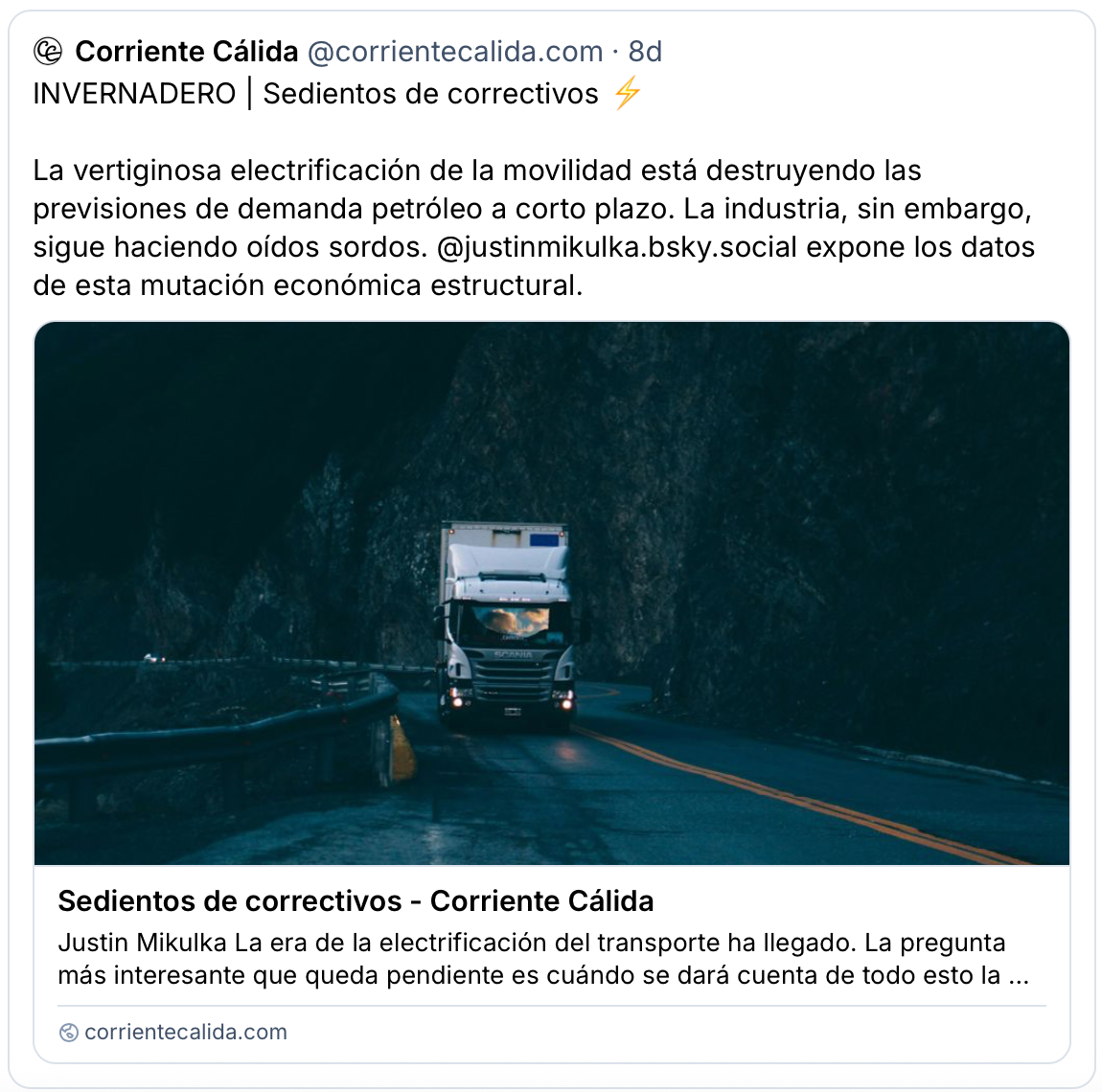
“Los grandes planes para el GNL no están saliendo bien, ya que el mundo sufrirá un exceso de oferta masivo de GNL durante los próximos cinco años y probablemente durante mucho más tiempo. ¿Por qué? La destrucción de la demanda”, escribió, por ejemplo, Justin Mikulka, un reputado observador de los mercados energéticos globales.
Also a translated version of a Powering the Planet article published in Spain.
Multiple quotes in an article on an LNG terminal in Peru.
“The idea that LNG is presented as a ‘non-polluting fuel’ in the documents is total madness and obviously completely untrue,” said Mikulka. “The fact that this is written down in the documents shows that they have been put together without any rigor or commitment to ensuring proper standards.”
A financial analyst on LinkedIn making their case about LNG markets and then giving me the nod on getting deeper into the details.
“This is before considering the possibility that US production might fall below the EIA's forecast, something experts like Justin Mikulka might have a better handle on.”
Here is some feedback on my latest piece. This is the type of stuff public relations people use to sell their services to prospective new clients.
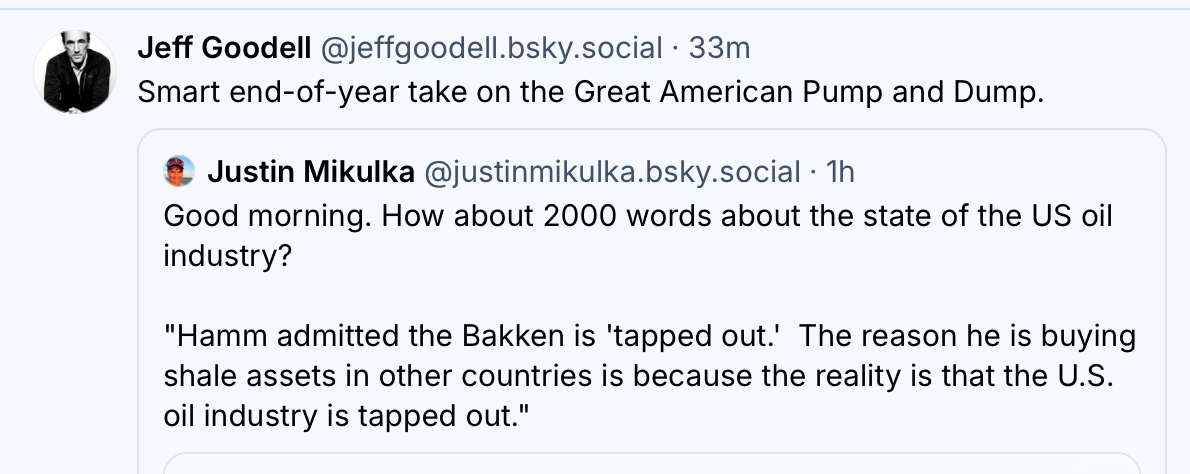
That all happened in December. I’ve worked in ad agencies. I worked on political campaigns. I currently work in communications. I’ve sat in a lot of meetings in large corporations where the “impacts” of a PR campaign are discussed. I’m quite confident that any PR company would be bragging about those above results which are all from December. They probably would be getting $10K or more for that month’s work and signing a fat contract for more of the same in 2026.
The world needs more real journalism done by experts. It needs more analysis to help the public see through the lies. It’s not hard to find a climate-focused non-profit argue about how we need a just transition for future oil workers who will lose their jobs but no one seems to care about the journalists who are making poverty level wages and end up leaving journalism out of financial necessity.
We are losing an information war because we want to fight it with a volunteer effort. Perhaps the people who want to hasten the phase out of fossil fuels should consider funding the journalists and analysts who can tell the world the story about why that is now the smart choice from an economic standpoint – as the public keeps getting higher energy bills .... and being told renewables are the reason.
Thanks again to my subscribers. 2026 is going to be a wild ride in the energy world and I will have things to say.
Comments ()