Global LNG Industry Growth Will Be Casualty of War
A year ago I wrote this:
“The global LNG industry has an economics problem.”
That was from an article about how India was more likely to move to renewables to replace coal power generation than LNG (liquefied natural gas aka methane). How did that last year go? By September, Bloomberg reported this:
“India’s annual liquefied natural gas demand is set to contract in 2025 for the first time in years, as buyers hold out for a surge in production that is expected to push down prices.”
India’s LNG imports were down around 10% at that point and Bloomberg highlighted the point I’ve been making — it’s simple economics and LNG is too expensive.
The other country that was supposed to drive LNG growth was China. In 2025 China’s LNG imports were down 12%. In early February Reuters ran a piece saying China’s LNG imports were expected to “recover” in 2026.
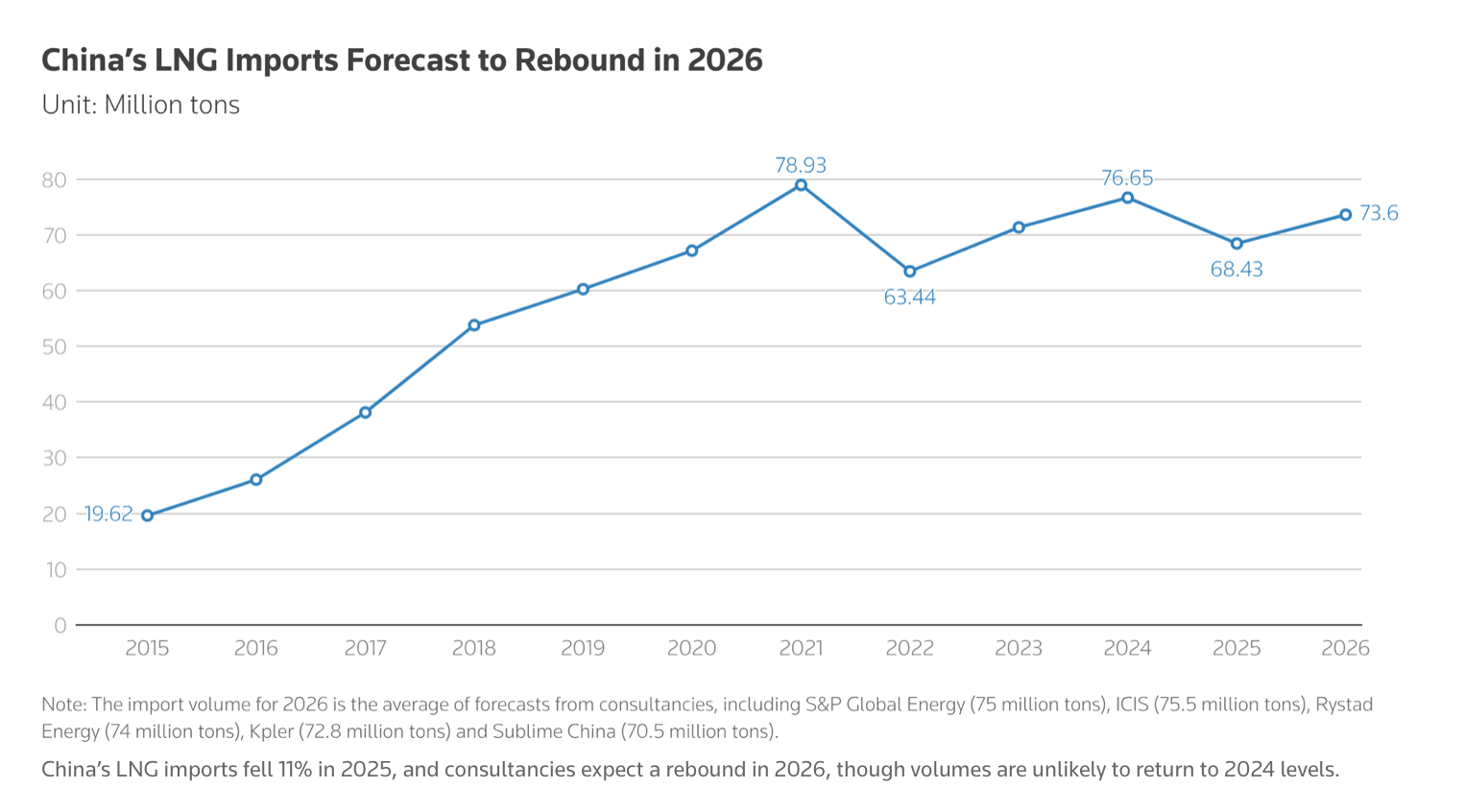
For the first two months of 2026 China’s LNG imports did not “recover” but remained flat. That was before Trump’s new war raised the prices of Asian LNG….by a lot.
In January the Economic Times of India reported that:
“Major buyers including Gail India Ltd. and Bharat Petroleum Corp. have been pushing for lower prices and more flexible long-term contracts, leaving discussions with LNG producers stalled for more than a year, according to people familiar with the matter. That approach could be rewarded if prices drop as new projects from the US to Qatar come online.”
Those were different times. India was paying around $12 per mmBtu for LNG and the buyers were saying it would take prices closer to $6 per mmBtu to increase LNG volumes. As I’ve explained, if global LNG prices got to $6/mmBtu, there is no money in the U.S. LNG export business. Of course, now India is paying north of $20/mmBtu for LNG.
Even before the impact of this war, the economics of LNG didn’t work for India. Now consider what Bloomberg reported recently.
“Electricity from a four-hour battery is now cheaper in almost every market that depends on LNG”
In related news, India is replacing its coal power generation, with renewable power.
“India's solar power capacity is expected to quadruple over the next decade, while wind energy capacity could triple, according to a report published on Thursday by an adviser to the country's power ministry. The jump in renewables is expected to reduce India's dependence on coal as a primary source of electricity generation to 49% by 2035-36, from more than 70% currently…”
Natural Gas Intelligence recently reported this:
“LNG exports to the three largest Asian gas buyers fell in February to the lowest point in a year and are trending to drop slightly lower in March, according to Kpler predictive data.”
And this from oilprice.com:
“Per Kpler data, China’s LNG imports this month will come in at 3.38 million tons. This would be the lowest since April 2018 and a palpable decline from February 2025, when imports of LNG clocked in at 4.47 million tons.”
Palpable decline. As you can see, LNG had an economics problem which was already destroying demand growth. And it just got much worse thanks to Trump.
Trump’s War Drives LNG Demand Destruction
In the pre-war days I was asked on LinkedIn about my predictions of a coming LNG glut and what would happen if there was a war in Iran and they closed the Strait of Hormuz. This was my response:
“As usual, the oil and gas industry can always resort to war to make their business model work. I would argue that everyone should expect this and that is why relying on imported oil and gas is dangerous for energy security.”
Two weeks ago on LinkedIn I also pointed out that the war would result in short-term LNG profits while destroying its future markets as everyone will just switch to renewables for power generation and batteries for trucks and they will not switch back.
And here we are. The media coverage of this war-driven fossil fuel energy crisis is much different from the one in 2022. Here was the Associated Press after three weeks of war.
“The war in Iran is exposing the world’s reliance on fragile fossil fuel routes, lending urgency to calls for hastening the shift to renewable energy.”
The world was already moving away from expensive LNG and reliance on imported fossil fuels. Trump’s latest war-of-choice will accelerate the demise of the global LNG industry.
I’ve written about Pakistan’s situation before. It is a great story. In the war-driven fossil fuel crisis of 2022, commodities traders resold LNG that was contracted to go to Pakistan. They resold it to Europe for a lot more money and left the people of Pakistan high and dry. The people and industry of Pakistan fought back by installing a huge amount of solar and storage. 2022 was the first time this was an economically viable option during an energy crisis. So, how’d that go for Pakistan reducing its reliance on LNG?
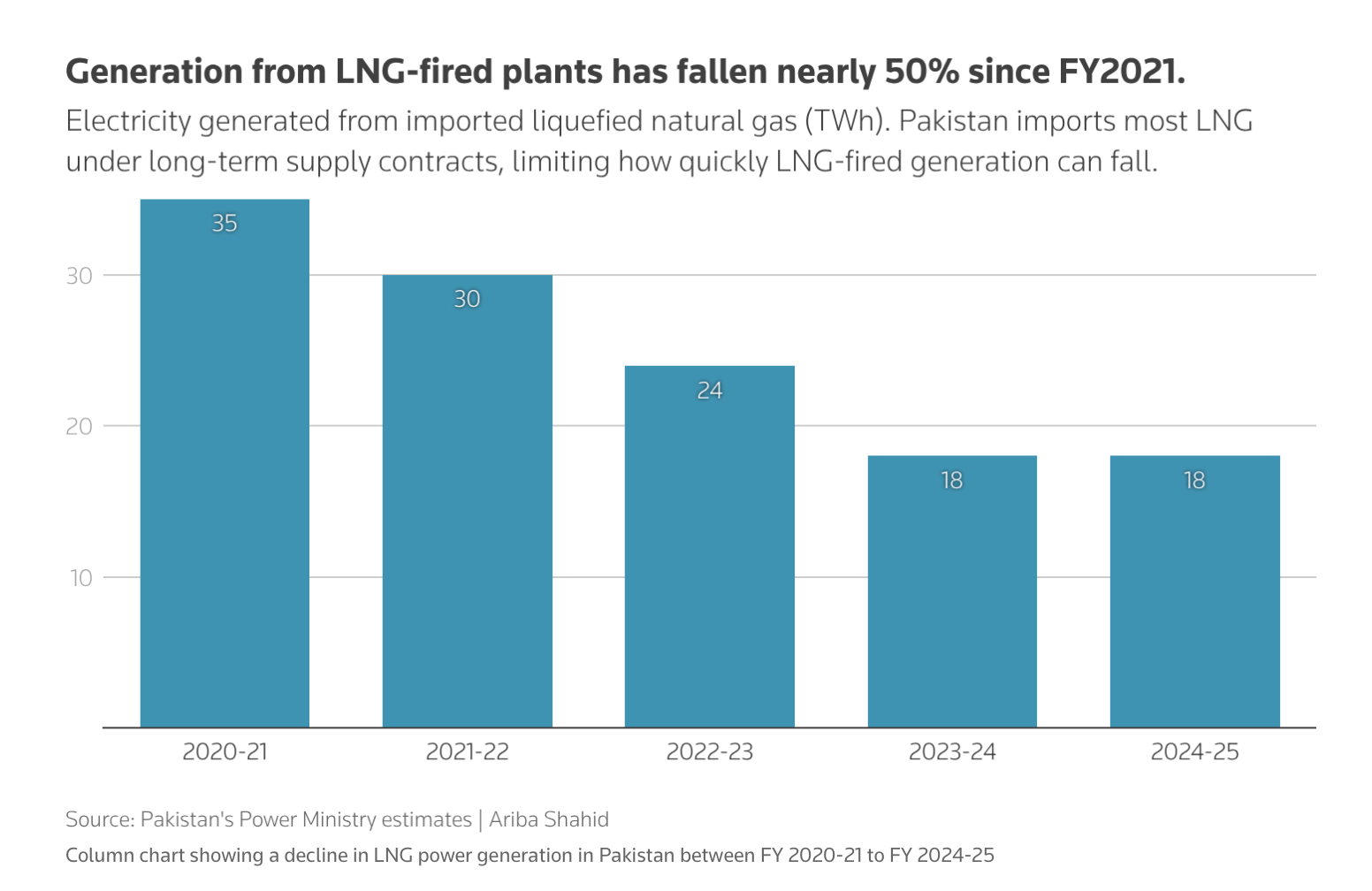
Expect a lot more countries to take this approach.
Ira Joseph is one of the most-respected LNG analysts in the game. His latest insights in Natural Gas Intelligence won’t come as a surprise to anyone who had been reading Powering the Planet but are somewhat shocking to see in the pages of Natural Gas Intelligence.
"Ira Joseph, a senior research associate at Columbia University’s Center on Global Energy Policy, told NGI the U.S. LNG industry could see an immediate windfall from a prolonged outage in Qatar, despite limited ability for exporters to fill the gap.
However, a return to record high prices would also push out emergent LNG buyers in Asia and incentivize a switch to cheaper fuels.
“There's going to be a lot of demand destruction, both short-term and permanent, from this.”
Permanent demand destruction for LNG. It’s been easy to see this coming if you pay attention but the war just made it that much more clear to a whole lot more people. Remember earlier this year the biggest LNG buyer in India said that they would be buying more LNG if prices hit $6/mmBtu? Bloomberg expects $26/mmBtu as the price for Asian LNG in the near future.
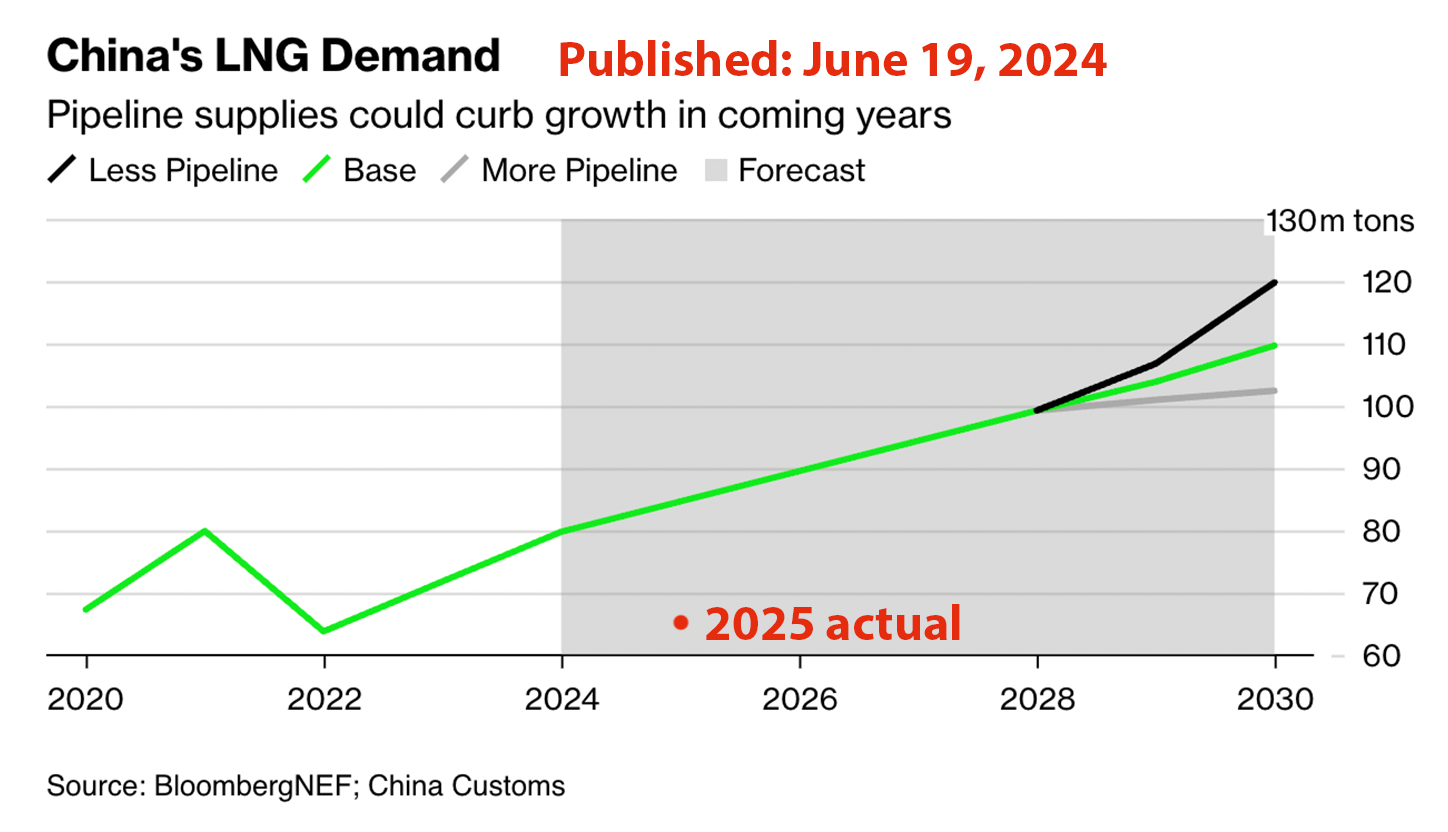
In June 2024, Bloomberg’s BNEF published their LNG growth forecast for China and they have proven to be far too optimistic. The rapid fall in cost of solar and batteries changed everything. Very fast. Doubling LNG prices right now will accelerate what was already happening. Less than two years ago they were predicting China would be importing around 90 million tons of LNG in 2026. It seems like they may not even break 70 in 2026.
More so than ever, the LNG industry has an economics problem. And there is no fix. So, it will be replaced by lower cost solutions. Which will make the world a safer, healthier and less expensive place. It also will help address the climate crisis as reducing methane emissions is our best chance to do that.
Comments ()